Introduction: Greece’s Untamed and Rugged Frontier
When most travellers think of coastal Greece, they imagine the whitewashed cubic houses and blue-domed churches of the Cyclades, or the lush, pine-fringed bays of the Ionian islands. But there is a region in the far south of the Greek mainland that offers a completely different aesthetic and atmosphere. Tucked away on the middle prong of the Peloponnese peninsula lies the Mani. Defined by the rugged peaks of the Taygetos mountain range sloping steeply into the Ionian and Aegean seas, the Mani is a wild, sun-drenched landscape of olive groves, rocky coves, and dramatic stone tower villages. For UK travellers seeking an authentic, slow-paced Greek escape with a touch of adventure, the Mani Peninsula represents the ultimate coastal frontier. This guide explores the unique architecture, history, beaches, and gastronomy of this captivating region.
Limeni and Areopoli: The Stone Capitals of Mani
The Mani is traditionally divided into two parts: Exo Mani (Outer Mani) in the north, which is greener and gentler, and Mesa Mani (Inner Mani) in the south, which is arid, rugged, and highly dramatic. The gateway to Inner Mani is the historic town of Areopoli, perched on a high plateau overlooking the sea.
Areopoli is a beautifully preserved settlement of stone houses, narrow cobbled alleys, and historic squares. It played a pivotal role in modern Greek history: it was here, on March 17, 1821, that the Maniot clans raised the flag of rebellion, sparking the Greek War of Independence against the Ottoman Empire. Today, the town is a lively hub of boutique hotels, traditional cafes, and tavernas serving local delicacies.
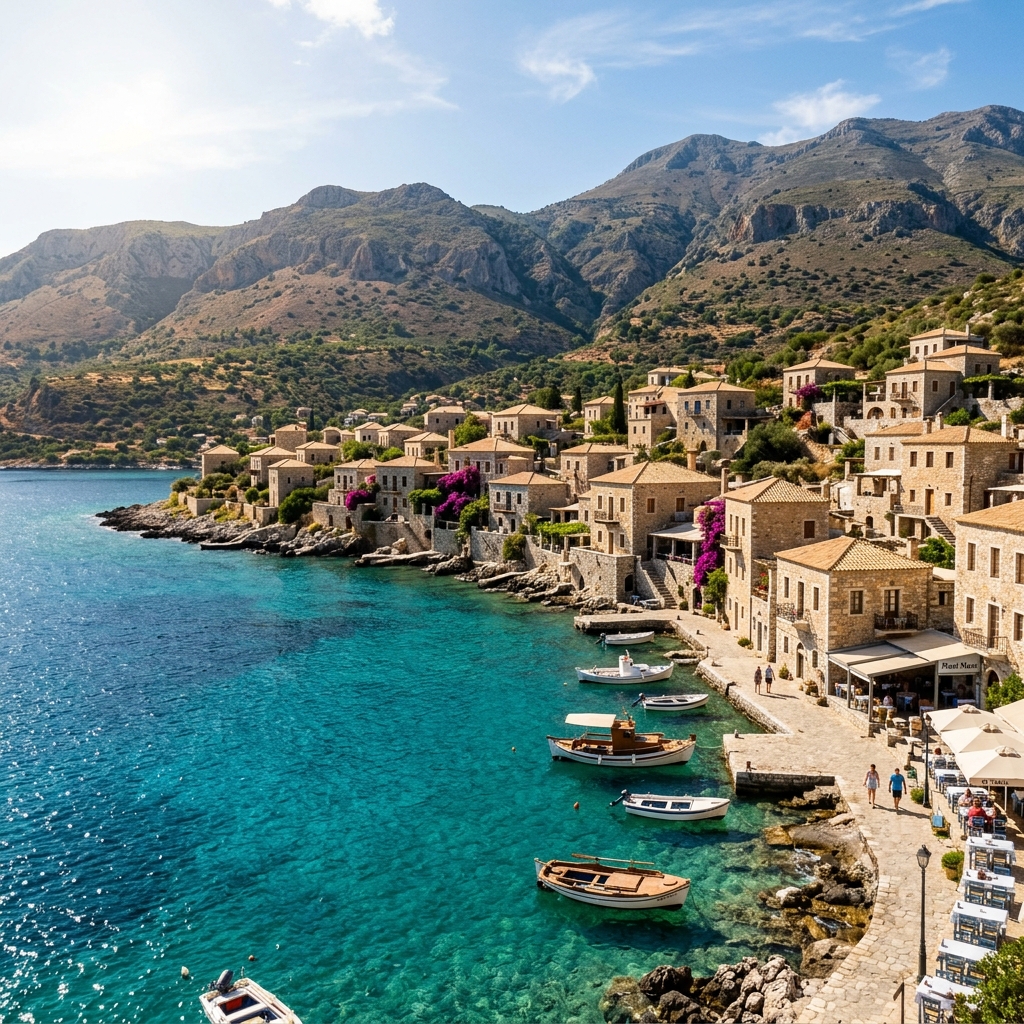
Just a short, winding drive down the cliff from Areopoli lies Limeni, perhaps the most picturesque coastal settlement in the Peloponnese. Limeni is a tiny fishing village of traditional stone towers built directly on the edge of a remarkably clear, turquoise bay. There are no sandy beaches here; instead, visitors sunbathe on flat rocks and slide directly into the calm, transparent water, often sharing the bay with the local population of friendly loggerhead sea turtles (Caretta caretta). The waterfront is lined with fish tavernas where you can dine on fresh octopus and sea bass as the waves lap at your feet.
The Tower Houses of Mani: Built for Blood Feuds
What makes the Maniot landscape truly unique is its architecture. The region is dotted with over 800 defensive tower houses (pyrgoi). Historically, the Mani was populated by fierce, independent clans who were never fully conquered by foreign invaders, including the Ottomans. However, this fierce independence also led to intense rivalries and bloody, multi-generational blood feuds between local families.
To protect themselves, families constructed these stone towers, which could rise up to four or five stories high. Built with thick limestone walls, tiny window slits for firing weapons, and crenellated battlements, these towers were designed to withstand prolonged sieges. The most striking concentration of these towers can be seen in the abandoned hilltop village of Vathia in the far south, where a cluster of silent stone towers stands sentinel over the dramatic coastline.
The Mystical Caves of Diros
A short drive south of Areopoli leads to one of Greece’s most spectacular natural wonders—the Diros Caves (Vlychada Cave). This massive subterranean river system is one of the most significant cave complexes in Europe.
Visitors explore the cave via a guided 40-minute boat ride on a flat-bottomed boat, guided by a local punter through a maze of narrow channels and towering caverns. The caves are filled with spectacular stalactite and stalagmite formations, which are beautifully illuminated to highlight their varied shapes and colours. The water is crystal-clear and remarkably deep, reflecting the glittering mineral formations above to create an otherworldly, mystical atmosphere.
Culinary Delights: Olive Oil, Honey, and Wild Herbs
The gastronomy of the Mani is simple, rustic, and deeply rooted in the dry mountain landscape. The region is famous for producing some of the highest quality olive oil in Greece, pressed from the small, intensely flavorful Koroneiki olives grown in the local orchards.
Classic Maniot dishes include:
- Siglino: Cured pork belly smoked over local wild herbs like sage and rosemary, then boiled with orange peel and stored in olive oil. It is often served fried with eggs or tossed into local stews.
- Maniot Salad: A refreshing variation of the classic Greek salad, featuring local potatoes, oranges, tomatoes, wild capers, and crumbled Mizithra cheese, drizzled with local olive oil.
- Lalaggia: Traditional fried dough strips, crispy and lightly seasoned, eaten as a snack or paired with local cheese and honey.
- Diples: Thin sheets of dough rolled into scrolls, deep-fried until crisp, and drizzled with local thyme honey and crushed walnuts.
Travel Logistics for UK Travellers
Reaching this remote peninsula is part of the adventure, offering a scenic journey through the Peloponnese:
- Flights: Kalamata International Airport (KLX) is the main gateway, located about 1 hour and 15 minutes north of Areopoli. Direct flights are available from London, Manchester, and Birmingham during the spring and summer seasons. Alternatively, you can fly into Athens Airport (ATH) and rent a car; the drive to Mani takes about 3 to 3.5 hours on excellent, modern motorways.
- Car Hire: A rental car is absolutely essential to explore the Mani. The coastal roads are well-engineered, but secondary routes to the mountain villages and remote coves can be narrow, winding, and steep.
- When to Visit: May, June, September, and October are the ideal months to visit, offering perfect beach weather and comfortable temperatures for hiking, without the peak summer heat and traffic.
Expats and Retiring in Mani
For UK expats seeking a peaceful, authentic Greek life, the Mani Peninsula is an increasingly popular haven. Unlike the highly commercialized islands, the Mani remains relatively quiet year-round. The region offers a lower cost of living, exceptionally clean air, and a strong sense of local community. The presence of the Taygetos mountains and the sea provides a healthy, active outdoor lifestyle, making it a wonderful sanctuary for slow, traditional living.